


Технологія відбору проб ультрафортного лазерного імпульсу часового домену
З моменту виникнення ультракоротких імпульсів вони стали важливим дослідницьким інструментом у багатьох наукових галузях, таких як ультраошвидка спектроскопія, аттосекундна наука, генерація ТГц тощо, і точне вимірювання ширини ультракороткого лазерного імпульсу є передумовою для генерації та використання ультракоротких імпульсів.
Традиційні методи вимірювання, такі як фотодіоди та вимірювання автокореляції, можуть вимірювати лише оболонку імпульсу, але не може отримати фазову інформацію про імпульс ., щоб вирішити цю проблему, розвинувся різноманітні методи вимірювання імпульсу ультрашортного імпу Методи - це непрямі методи, які покладаються на алгоритми реконструкції . порівняно з непрямими методами вимірювання, методи прямих вимірювання використовують ультрашвидкі ворота для безпосереднього вибірки ультрашоторних імпульсів у часовій області .. Гейтс, такі як безпосередньо з використанням атмосекундних імпульсів, використовуючи іонізацію тунелювання, нелінійну технологію вибірки фотопровідності тощо .. Ці методи потребують вакуумних систем або потребують точного вимірювання фотострумів .
Технологія відбору проб імпульсу на основі збурення суцільної поверхні чотирихвильової змішування
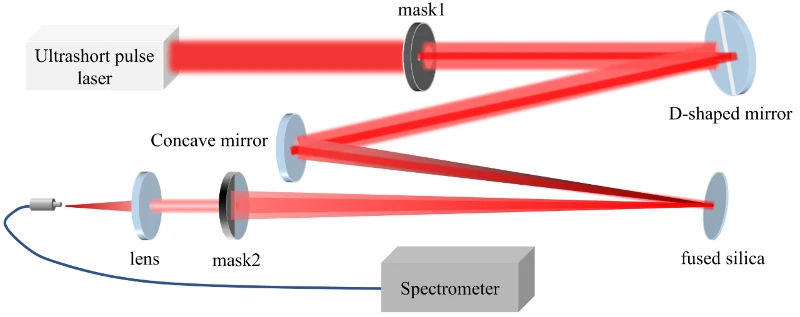
Нещодавно Центр досліджень науки та технологій Аттосоекунд Інституту оптики та точної механіки Xi'an запропонував нову технологію відбору часу для ультрафортних лазерних імпульсів . Ця технологія вимірювання базується на нелінійному оптичному ефекті третього порядку, що триває, що є ультрафіолетовим ультрафіолетовим переміщенням у Ultrashor Процес . Пристрій відбору проб ультрашортного імпульсного імпульсу показаний на малюнку 1. По-перше, ультрафортний імпульс імпульс поділяється на два лазерні імпульси, а саме основну частоту частоти та збурення світла, за допомогою маски1 та відносної затримки τ між цереном Decked jecore-piecodober-yweler jumoberodorodorodorodoore-jumodorodorodorodorodorodoor doworodoorodorodorodorodorodorodorodorodorodorodorodorodorodorodorodorodorodorodoroor Етап переміщення . Потім увігнутий відбивач використовується для фокусування двох на передній поверхні сплитого кварцового шматочка ., нарешті, Mask2 використовується для блокування відбитого фундаментального частотного світла та імпульсу збурення, а лінса використовується для фокусування генерації, що відображає чотири хвилеві змішані сигналізації в опітичному режимі}}}}} 13-ти сигналізацію}}}}}}} ineptical chodomitore}} 13 модульованому}}} optical cheptictritor in}}} optical chepticitrioury
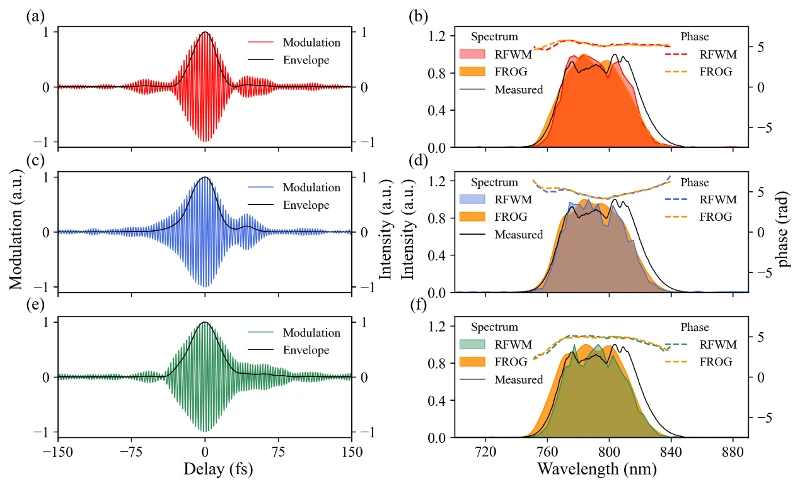
First, the experimental device was used to measure ultrashort pulses with a central wavelength of 800 nm and a pulse width of about 30 fs generated by a Ti:Sapphire laser system. Figure 2(a) shows the waveform of the reflected four-wave mixing modulation signal measured after filtering. The corresponding spectrum and phase in the frequency domain are shown in Figure 2(b). It can be seen that the phase is flat at this time, almost a horizontal line. Then, by changing the dispersion of the perturbation light pulse, the perturbation light pulse under different chirps was measured. The measurement results are shown in Figures 2(c)-(f). Figures 2(c) and 2 (d) відповідають позитивним лазерним імпульсам Chirp, а рисунки 2 (e) та 2 (f) відповідають негативним імпульсам CHIRP .
In order to verify the reliability of the ultrashort pulse time domain sampling technology, FROG was used to compare the ultrashort pulses. It can be seen from Figures 2(b), 2(d) and 2(f) that the results obtained by FROG and the time domain sampling technology are in good agreement. Subsequently, ultrashort pulses with a central wavelength of 1700 нм і ширина імпульсу приблизно 50 фс були успішно виміряні за допомогою цієї експериментальної установки та жаби .
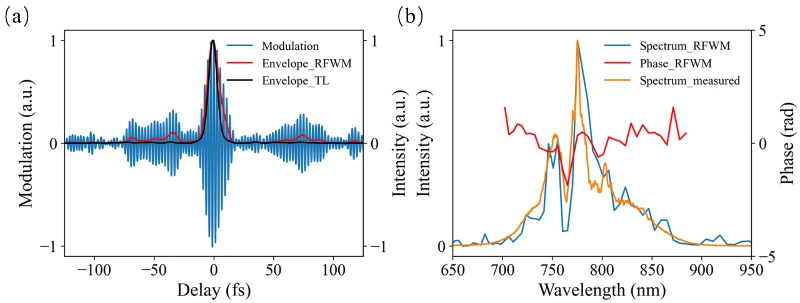
Since the sampling process occurs on the solid surface, the phase matching condition can be automatically satisfied, so this measurement technology is suitable for measuring few-cycle or even single-cycle pulses. Subsequently, a multi-thin-slice post-compression system was built based on the Ti:Sapphire laser system, and a few-cycle pulse with a central wavelength of 800 nm and a conversion limit of Близько 3 . 4 циклів (близько 9 фс) було отримано . після оптимізації дисперсії лазерного імпульсу після спектрального розширення та фільтрації, форма хвилі відбитого чотирихвильового змішування модуляції показана на рисунку 3 (a), а його ширина імпульсу-близько 12 fs .}} відповідна спектру.
The above measurement results show that the ultrashort pulse time domain sampling technology is suitable for characterizing short-cycle and few-cycle laser pulses. At present, the applicable wavelength based on the existing silicon-based and InGaAs detectors is 200-2600 nm. For laser pulses with a wavelength exceeding 2600 nm, traditional Детектори не можуть безпосередньо виявити чотирихвильові змішувальні сигнали ., щоб подальше розширити сферу застосування цієї технології вимірювання, ефект потрійної частоти буде використовуватися в майбутньому для опосередкованого вимірювання лазерних імпульсів з діапазоном довжини хвилі 2600-7800 nm .}}}
The Attosecond Science and Technology Research Center of the Xi'an Institute of Optics and Precision Mechanics was established in May 2021, led by researchers Zhao Wei and Fu Yuxi. The research center focuses on attosecond science and technology, and conducts research on high-power advanced laser technology, mid-infrared femtosecond laser, few-cycle laser technology, soft X-ray attosecond laser, attosecond electron microscope, ultrafast imaging, ultrafast dynamics, strong field laser physics, etc. The research center not only undertakes the construction of large scientific facilities of attosecond light sources, but also presides over a number of major national and provincial scientific research projects, including a number of National Natural Science Foundation, key R&D plans of the Ministry of Science and Technology, pre-research of major scientific and technological infrastructure of the Chinese Academy of Sciences, Shaanxi Natural Science Basic Research Plan, Shaanxi Attosecond Science and Technology Innovation Team and other scientific research projects. In recent years, the Attosecond Science and Technology Research Center has overcome the key processes and technologies of high-power thin-film lasers, achieved 1 kHz, 200 mJ-level Пікосекунд лазерного виходу та забезпечили ключові основні технології та пристрої для локалізації лазерів високого класу та будівництва передових аттосекундних лазерних засобів; запропонований та продемонстрував метод прямого вимірювання лазерного поля у часовій області; and broke through the key difficulties of attosecond time-resolved diffraction imaging. The Attosecond Science and Technology Research Center is driven by attosecond science and technology, conducts ultrafast scientific research represented by advanced ultrafast laser technology and ultrafast dynamics detection, and is committed to building an internationally renowned highland for ultrafast science and technology Дослідження .


